If you're trying to decide between a poured concrete driveway and pavers for your NYC home, here's the honest trade-off in one line: concrete costs less up front and gives you a clean, solid surface, while pavers cost more but flex with the ground, resist cracking, and can be repaired one piece at a time. Which one is "better" depends on your budget, your soil, and how you feel about the two ways these surfaces eventually fail.
Let's break it down the way a homeowner actually experiences it, not the way a brochure describes it, and cover the one NYC factor that most comparisons leave out.
| Factor | Concrete | Pavers |
|---|---|---|
| Upfront cost | Lower | Higher |
| Cracking | Cracks over time | Resists cracking |
| Repairs | Patch a whole section | Reset one piece |
| Typical lifespan | 20–30 years | 25–50 years |
| Winter salt | Can flake, needs sealing | Choose salt-rated |
| Weeds | None | Possible in joints |
Every hard surface eventually shows its age. The difference is how.
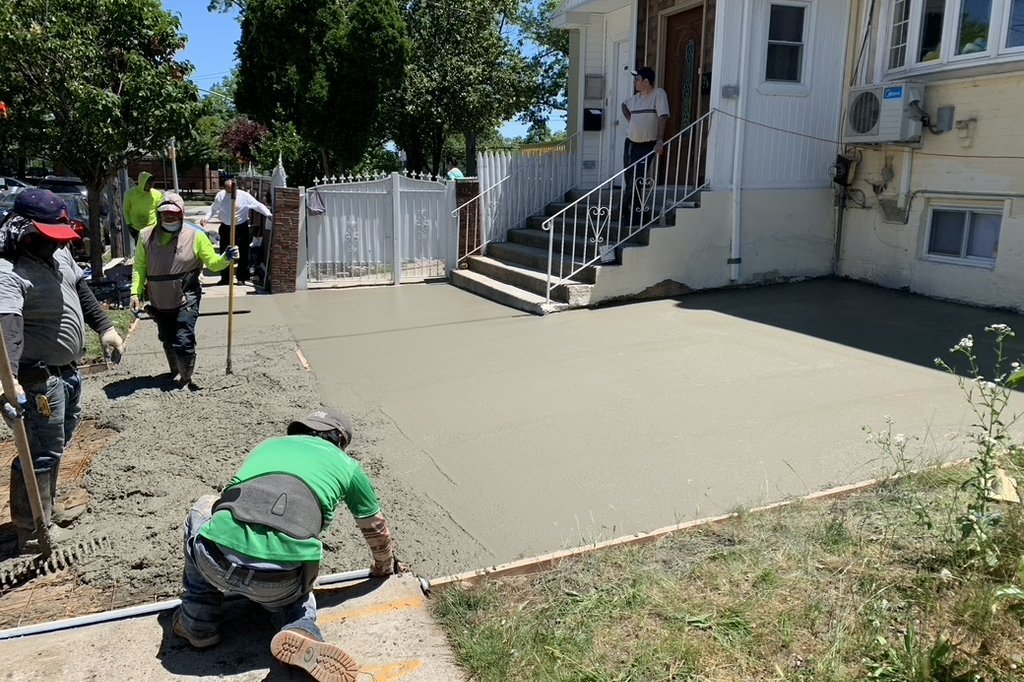
Concrete cracks, and once it cracks, it stays cracked. New York's freeze-thaw cycle is brutal on a large slab. Water gets into the ground under the concrete, freezes, expands, and shifts the base. A big continuous slab has nowhere to absorb that movement, so it cracks. There's a reason contractors cut control joints into fresh concrete, to steer where those cracks go, but they can't prevent them entirely. Homeowners describe it bluntly: once it's cracked it's cracked, and patching rarely blends in.
Pavers shift and settle, but they don't crack the same way. Because a paver surface is made of many small units, each one is basically a tiny slab. When the ground moves, individual pavers can lift or settle instead of the whole surface splitting. There's a good analogy people use: try to snap an ear of corn in half, then snap one of the halves, each smaller piece is harder to break. Pavers "give" under the weight of a car for the same reason. The downside is that they can go uneven over time and occasionally need re-leveling.
So the choice is really this: do you prefer a surface that stays flat until it cracks, or one that resists cracking but may need the occasional piece reset?
This one matters more in New York than almost anywhere, and most homeowners don't think about it until it's too late. Road salt and de-icing chemicals eat most pavers and damage concrete surfaces. If you salt your driveway every winter, standard pavers can spall and pit, and concrete can flake at the surface, a problem made worse by salt getting into hairline cracks and freezing inside them.
The workaround on the paver side is choosing a product rated for salt. Some manufacturers, like Techo-Bloc, warranty specific pavers against salt damage and color them all the way through, so a chip or scratch doesn't show a different color underneath. On the concrete side, a proper sealer helps, but it needs reapplying every couple of years to keep doing its job. If you go either route in NYC, winter durability is a question worth raising with your contractor directly.
Talk to anyone who's lived with pavers for a decade and weeds come up fast. Growth between the joints is the number one complaint, "we fight weeds all the time" is a near-universal refrain. Polymeric sand in the joints helps a lot and modern installations hold up far better than older ones, but it's a real maintenance item you should go in expecting.
Concrete has none of that: no joints for weeds, easy to clear with a pressure washer. Stamped and stained concrete can also be made to look like pavers, natural stone, or brick, which is why some homeowners choose it for the look of pavers without the weeds. The catch with stamped concrete: if the surface chips, the base color underneath shows through and it can look bad quickly, and repairing a stamped surface to match is difficult.
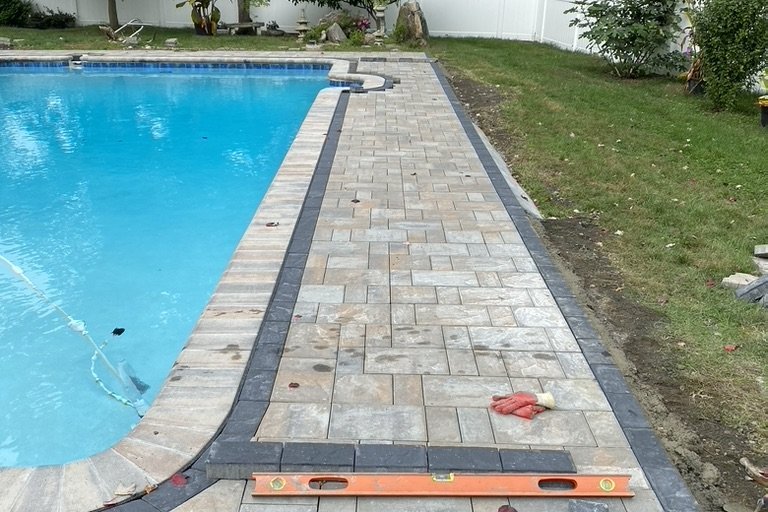
Here's where pavers genuinely win. If a paver cracks, sinks, or a tree root pushes one up, you or a contractor can pull that piece, fix the base or the root underneath, and set it back down, often invisibly. This is a real advantage in NYC, where street trees and their roots are everywhere. With concrete, the same tree root cracks the slab, and now you're patching or replacing a whole section.
That repairability is a big reason pavers often last longer in practice, roughly 25 to 50 years for pavers versus 20 to 30 for concrete, even though pavers cost more to install.
There's no getting around it, pavers cost more up front. The material costs more and the installation is more labor-intensive, because a proper paver job lives or dies on the base preparation: excavation, a well-compacted gravel base, and solid edge restraints. Skip that and pavers shift no matter how good they look on day one.
Concrete is cheaper to pour and faster to install. Stamped and decorative concrete sits in the middle, more than plain concrete, usually less than a full paver installation. The way to think about it: concrete is the lower upfront cost, pavers are the lower lifetime cost if you factor in easier repairs and longer life. Neither is "wrong," they're different trade-offs for different budgets and priorities.
The best pick can change with the use:
Rough guidance based on how these actually perform in NYC:
The single most important factor for either one? The base. A cheap install on a poor base fails fast whether it's concrete or pavers. That's the part you can't see, and the part that determines how long it lasts.
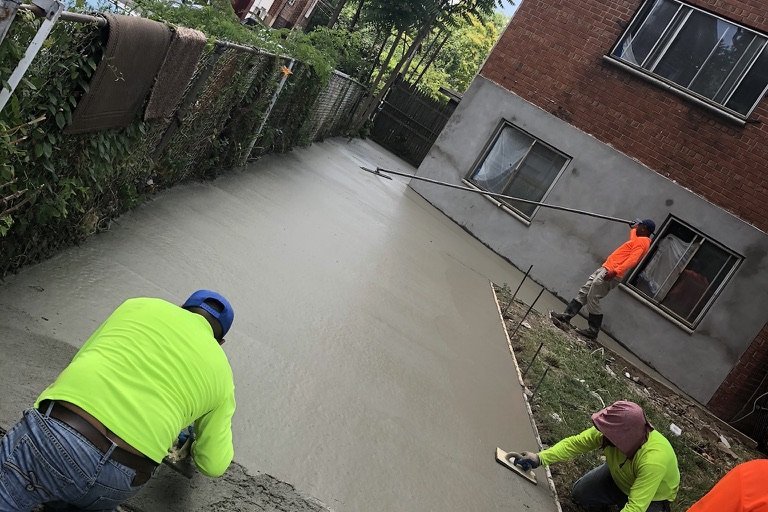
At NYC Concrete Contractors we install both, and we'll give you a straight answer based on your actual driveway or patio, your soil, tree situation, and budget, not a one-size pitch. We handle the part that matters most, proper excavation and base prep, so whatever surface you choose actually lasts.
